Professional Proofreading
The Basics
Each correction mark drawn must be repeated in the margin. The required change is to be drawn to the right of the repeated correction mark, unless this is not the case (such as , ) speaks for itself.
Correction marks must be sent to correction points quickly and can be clearly assigned. That’s why it’s important with a high density of errors, it is important to use various, freely selectable correction symbols - if necessary also in different colors.
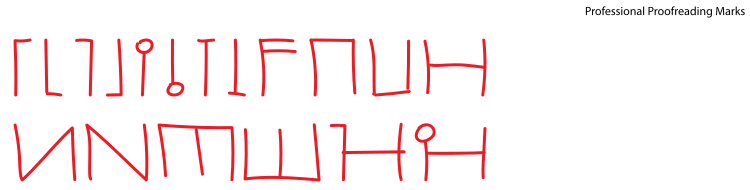
A different font or font size is requested by underlining the relevant place and writing the desired font in the margin. Font (bold, italic, etc.) or desired font size (8p, 9p, etc.) or both (8p bold, 9p italic, etc.) noted. Desired italics is often just a wavy line under the word and on the called edge. Accidentally incorrect highlighting will also occur underlined; The instruction on the edge then reads: “Basic font” or “ordinary”.
Letters incorrectly set from other fonts (onion fish) are crossed out and underlined twice in the margin. Incorrect letters or words are crossed out and displayed on the Rond replaced with the correct ones.
Each correction mark drawn must be repeated in the margin. The required change is to be drawn to the right of the repeated correction mark, unless this is not the case (such as , ) speaks for itself. Correction marks must be sent to correction points quickly and can be clearly assigned. That’s why it’s great For error density, it is important to use various, freely selectable correction symbols - if necessary also in different colors. etc. Incorrect separations are marked at the end of the line and at the beginning of the following line. If, after deleting a hyphen or letter, the spelling of the remaining parts becomes doubtful, then, in addition to the deletion symbol, the combination is replaced by a double sheet, the separate spelling is indicated by the symbol, e.g. B. dazzling white. Missing letters are indicated by the preceding or The following letter is crossed out and together with the missing one is repeated. The entire word or syllable can also be punctured and corrected in the margin. Missing words (corpses) are indicated in the gap by chevrons made and stated on the edge. For major omissions, reference is made to the manuscript page. The The location must be marked on the manuscript page. This press consisted of was attached. Letters or words to be deleted are crossed out and up marked on the edge by (for: deleatur, i.e. “let it be erased”). Punctuation marks that are missing or need to be deleted are marked like letters that are missing or need to be deleted
Misplaced letters are crossed out and printed in the margin given in the correct order. Distorted words are marked with the conversion symbol. The words are numbered for larger changes. If the change is difficult to understand, it is recommended to delete the changed text completely and repeat it in the correction margin. Misplaced numbers must always be crossed out completely and in the correct form Write a sequence of numbers on the edge, e.g. B. 1684. For illegible or doubtful passages in the manuscript that have not yet been blocked, as well as for text that still needs to be added, the proofreader will issue a Blockade required, e.g. E.g.: Hyladens are insects with an immobile prothorax (see p. …). Blocking or revoking a blocking is the same as with a request another font is marked by underlining.
Missing space between words is denoted by . If the gap is too wide, the gap is marked through if the gap is too narrow. If one space is to be completely eliminated, this is done by two Bow indicated without line. Missing line spacing (leading) is marked by a line drawn between the lines with an arc that is open to the outside. Line spacing (leading) that is too large is caused by a line between the Lines drawn with an arc that is open inwards. A paragraph is required by the character in the text and in the margin: The oldest prints are so uniformly beautifully executed that they are the most beautiful Excel in handwriting. The oldest printing press seems to be the one that Jost gave us Amman shown in the picture in 1568 was not significantly different be. Attaching a paragraph requires you to include the output line connecting the following text: The press consisted of two vertical columns connected by a cornice were. The printing form was mounted on a movable cart half the height of a man.
The indent to be canceled is marked on the left edge and on the right Edge the character, e.g. E.g.: The printing press is a fascinating machine, its artistic Mechanism can only be understood by those who have worked on it themselves. Missing indentation is indicated as precisely as possible, e.g. B. (if the indentation of one square is required): … no type of metal printing existed beyond the end of the 14th century. The woodcut also did not appear in printed works before the 14th century. If you accidentally correct something wrong, you can undo it by: The correction on the edge is crossed out and points under the incorrect ones corrected position.
Ligatures (contracted letters) are required by Cross out the letters that were incorrectly placed next to each other and repeated on the edge with a bow underneath, e.g. B. Ship. Incorrectly placed ligatures are crossed out, repeated in the margin and separated by a line, e.g. B. Edition.
Further Examples
If several errors occurred in oiner Zeele, then they receive different characters in their order. For one and the same incorrect letter, only one correction mark is used, which is placed several times in front of the correct letter. Missing lines are indicated with on the left edge of the text preceding and following line. first line third line When making corrections, excessive separations should be pointed out, which should be reduced by moving them if possible. For long lines there should be no more than 3, for short ones (e.g. in a dictionary or lexicon) no more than 5 separations follow each other.